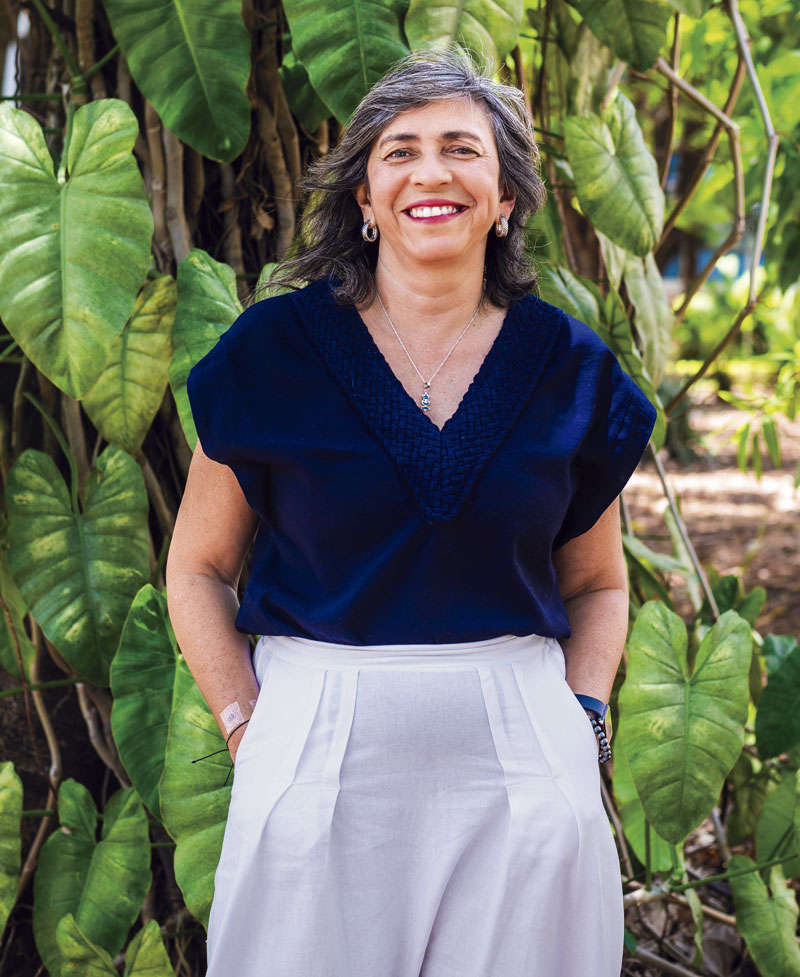
 Diego BresaniFor a decade, geographer Ane Auxiliadora Costa Alencar, 52, has maintained an unchanging commitment at the end of each year: boarding a plane to a different world city to participate in the Conference of the Parties (COP) of the United Nations Framework Convention on Climate Change (UNFCCC). She has not missed a single one of the meetings since 2015, when COP21 took place in Paris. This year will be no different, but the stage for COP30 will be in a very familiar location: her hometown of Belém.
– COP30 seeks more ambitious global targets to reduce emissions and curb global warming
– In 30 years, COP has become the largest annual United Nations conference
– Large trees consume and store more carbon
– How tourism affects climate change and vice versa
– Ghanaian climatologist says poor countries need financial and technological support to tackle global warming
– Scientific expeditions head into little-explored areas of the Amazon
Alencar, director of science at the Amazon Environmental Research Institute (IPAM), a scientific civil society organization founded 30 years ago in the Pará state capital of Belém, is a specialist in remote sensing. She studies the impact of wildfires on the Amazon rainforest and the Cerrado (a wooded savanna biome). She is also head of the MapBiomas Fogo mapping project, which involves a collaborative network of more than 70 nongovernmental organizations (NGOs), universities, and technology startups using satellite imagery to record forest fires in Brazilian ecosystems monthly and annually.
Since 2010, the geographer has lived in Brasília, home to one of IPAM’s seven units. In addition to the Brazilian capital and Belém, the organization employs 160 people—60 in the science department—at offices in two other cities in Pará, two in Mato Grosso, and one in Acre.
According to the researcher, part of Brazilian society still sees environmental issues as ideological talking points of the left. “There are people who do not realize that climate change will impact everyone, including themselves,” she says. In this interview, conducted via video conference, Alencar talks about her expectations for COP30, her research on fires in the Amazon and Cerrado biomes, and how her childhood passion for maps and rocks led her to become a scientist.
Was Belém a good choice for COP30?
It was a great choice, despite all of its problems. The city is emblematic of a region—the Amazon—which is on everyone’s mind. There are many people around the world who do not know the capital of Brazil, but they know what the Amazon is.
Remote sensing and forest fires
Institution
Amazon Environmental Research Institute (IPAM)
Educational background
Bachelor’s degree in Geography from the Federal University of Pará (1995), master’s degree in remote sensing and geographic information systems from Boston University, USA (2000), and PhD in forest resources and conservation from the University of Florida, USA (2010)
Could the high cost of accommodation limit participation in COP30?
That problem would occur to some extent in any Brazilian city chosen to host the COP, whether it was Belém or somewhere else. I can talk a little about my experiences. I have attended every COP since the one in Paris in 2015. At every one, I have had to pay between US$200 and US$250 per night for a hotel. In Glasgow, Scotland, in 2021, I found a place to stay that was a plastic house, basically a campsite, outside the city. It took me an hour by train to get to the conference venue. I was in New York last September during Climate Week, and the hotels were around US$500 per night. I did not pay that amount because I stayed at a friend’s house.
But there are some places in Belém charging even more than that.
Indeed, some of the prices in Belém are very high and Brazil could have been better prepared for this situation. The government could have regulated prices. The biggest problem is the rates being charged by hotels in Belém—and there are not many hotels there. But it is possible to find houses and apartments available for less than US$200 per night. During the Círio de Nazaré religious festival, Belém welcomes thousands of people. But they are pilgrims, they sleep in hammocks or at the homes of friends and relatives. They are not diplomats visiting for a climate conference, who need more comfort to participate in two exhausting weeks of negotiations.
Will the rainforest be one of the major topics at COP30?
Holding the COP in the Amazon presents an opportunity to give countries in the region and local communities a voice on the global stage. That does not necessarily mean that rainforests will be the central topic of discussion. Fossil fuel burning is currently responsible for 87% of global emissions of carbon dioxide—the main greenhouse gas driving climate change. That needs to be a key focus at the COP, especially the topic of mitigating and reducing greenhouse gas emissions. The last two COPs were held in oil-producing countries—Dubai, United Arab Emirates, and Baku, Azerbaijan—because we need to reach an agreement that incentivizes a transition from a global economy based on fossil fuels to one based on renewable energy. Today, changes in land and forest use, essentially the process of deforestation, account for about 10% of global greenhouse gas emissions. Brazil is responsible for about a quarter of global emissions associated with land-use change, making it particularly important to the debate. It is therefore crucial to also discuss the Amazon at COP30. But that discussion should not overshadow the primary objective, which is to reduce emissions from burning fossil fuels and to accelerate the energy transition. We should aim to include significant emission reductions in the new NDCs [voluntary global warming reduction targets set by countries].
There are many people around the world who do not know the capital of Brazil, but they know what the Amazon is
In your opinion, what should be the main issues to negotiate at this COP?
For a long time, we have mainly discussed the issue of mitigating climate change by reducing emissions worldwide. That is a commitment that has been made in international agreements. At the last three COPs, the issue of adaptation—what countries are doing to limit the impacts of climate change—has gained greater prominence. It is now clear that we have to do both things simultaneously. We have to change the tire while the car is moving. The goal of limiting global warming to 1.5 °C above the preindustrial period is becoming increasingly unachievable. We already spent an entire year with temperatures above that threshold across 2023 and 2024. Mitigation is still the main topic, but the issue of adaptation is gaining traction within the climate convention. That includes a discussion about losses and damage, which countries are being impacted by extreme weather events, and how these effects could be mitigated through funding.
An annual climate financing goal of US$1.3 trillion was advocated for by a group of nations at the COP, including Brazil. What is the objective?
At the beginning of the discussions, the aim was primarily to fund mitigation efforts and the energy transition process. In recent years, adaptation has grown in prominence. The two issues are currently battling for resources. But at the moment, wealthy countries are unwilling to invest in these areas because they are prioritizing other domestic issues, such as wars, internal inequalities, recovering from the COVID-19 pandemic, and the impact of US trade tariffs. They believe they need to work internally first to resolve these political and economic issues. It is an inward-facing approach that complicates the financing goal and intensifies the friction between the Global South and the Global North. Climate change was driven by excessive emissions in the more developed Global North. But now all of us have to pay the bill, and the consequences are greatest for the least developed countries and the poorest sectors of society.
Brazil has a cleaner energy mix than most countries, but it continues to pursue oil exploration, including in the so-called Equatorial Margin, which includes the region near the Amazon River mouth. Does that undermine the country’s image at COP30?
In Brazil, the main source of greenhouse gas emissions is forest fires, not fossil fuel combustion. The conversion of forest areas—especially in the Amazon—to other uses, such as agriculture, and the management practices applied to this land are the main sources of greenhouse gases in Brazil, accounting for 74% of emissions. Since 2022, the country has significantly reduced these emissions. So I think Brazil is in a strong position for the COP. We have also invested heavily in renewable energy. I do not follow the issue of domestic industrial emissions closely, but waste management is improving and Brazilian agriculture is modernizing, striving to be more regenerative and store more carbon in the soil. We are seeing a shift in the agricultural sector.
But does exploring for oil, especially in the Amazon, make sense amidst the rise of electric cars?
The decision to explore for oil in the Equatorial Margin puts Brazil in a very difficult position. For a country that wants to establish itself as a climate leader, that has done its homework, putting this on the agenda is contradictory. The world is changing. The combustion of fossil fuels for energy and transportation remains a major source of emissions in many countries. China, however, has been revolutionizing the electrification of transportation, and now almost every mode of transport there is electric, from cars and buses to motorcycles. The streets of major cities are much quieter. It was a very rapid change. India is working toward the same goal. I do not know if it is worth it for Brazil to invest in drilling oil wells, a decades-long commitment that could become obsolete due to the rise of electric vehicles. Not to mention the country’s potential to invest in biofuels.
Some people do not realize that climate change will impact everyone, including themselves
Do you believe it is possible to reach an agreement on the US$1.3 trillion climate finance goal at COP30?
It is an enormous change of scale. At the last COP, the amount was increased from US$100 billion annually to US$300 billion. And even that initial amount of US$100 billion never actually reached developing countries. I would like to believe that the US$1.3 trillion target can be achieved at COP30. But given the current geopolitical landscape, I think it is unlikely to happen. The polarization of environmental issues, not only in Brazil but worldwide, does not help.
How so?
For many, climate change is seen as a progressive ideological issue, especially the reduction of emissions. That impedes the discussion. I recently listened to a European podcast that emphasized this point. For some parts of society, these issues are not seen as problems that need to be resolved. There are people who do not realize that climate change will impact everyone, including themselves.
They think the economic cost mitigation and adaptation actions are too high.
But the cost of the impacts of climate change will be far higher. It is a collective challenge that needs to be treated as a long-term investment. One country alone cannot carry the burden. Everyone has to contribute. In Brazil, for example, agriculture suffers when crops fail due to extreme weather events. Much of the deforestation in the Amazon, which is illegal, occurs on public land, which is the target of land grabbing and speculation by criminal organizations. They profit from it. Of course, not all rural producers do this, but those who work within the confines of the law need to take a stand and stop dismissing environmental issues as being at odds with agriculture.
Let’s talk about your research. Why did you decide to study wildfires in the Amazon and the Cerrado?
Brazil is a country of continental proportions containing several different biomes. A lot of the ignition sources that cause fires are of human origin, especially in the Amazon, which covers half of the country. In this biome, which is naturally more humid, it has to be extremely dry for lightning to cause a wildfire. In Brazil, especially in the Amazon, most fires occur during the driest period between August and October, when there is little rain and thus lightning is uncommon. In the Cerrado, Pantanal, and Pampas biomes, on the other hand, fire is part of the ecological cycle. There, wildfires can be started by lightning. But even in those biomes, most fires are caused by humans, just like in the Amazon. In the Amazon and the Atlantic Forest, naturally occurring fires are very rare.
How do natural forest fires start?
In fire ecology, there are three types of ignition sources considered natural. The most common is lightning. The second is active volcanoes, which we do not have here in Brazil. The third is rockslides, through which friction causes sparks that can ignite dry grass. The latter is highly specific and does not occur in Brazil either. So here, the majority of natural ignition sources are lightning strikes, which occur mainly in the Cerrado and the Pantanal. The vegetation in the Cerrado is very heterogeneous due to the topography, soil conditions, and fires. In this region, wildfires typically occur during the transition between seasons, when there are big thunderstorms in more open areas. When a lightning strike causes a fire, sometimes the rain from the storm makes the ground damp enough that the fire cannot spread. This is a natural process that does not cause large fires. The problem is that human activities are impacting this natural process, even in environments like the Cerrado, which has historically been accustomed to wildfires.
What is causing this impact?
Many people use the natural fields of the Cerrado and Pantanal as pasture areas, which they renew using fire. In addition to providing a fertilizer for the soil, fire causes grasses to regrow more healthy and palatable to livestock. Traditional farmers know that fires should not be started at the peak of the dry season, when there is a high risk of uncontrolled burning and loss of investment. They typically use fire at the beginning of the dry season or when rainfall is expected imminently.
How is fire linked to deforestation in the Amazon?
The tons of trees and vegetation that are felled have to go somewhere to make way for pasture or agriculture. There are several ways to get rid of this biomass: shred it and let it rot, remove all the wood, or simply burn it. Soil quality in the Amazon is poor. If all the wood is removed, the soil will not be able to support healthy crops or pasture. Shredding vegetation and letting it decompose, which is another way of enriching the soil with nutrients, takes a long time and requires specific machinery and technology. But burning the biomass returns some nutrients to the soil through the ashes and makes it possible to plant again soon after. Thousands of people do this in the Amazon. For smallholders and Indigenous people, it is a matter of food security and subsistence. This has been happening on a small scale for thousands of years. The problem now is that MapBiomas data has shown that pasture burning, especially for newly cleared land, is responsible for many of the ignition sources in the Amazon. The use of fire in these areas needs to be controlled.
Are you saying that in the Amazon, fire is used primarily to clear recently deforested areas and then periodically to renew the pasture?
Exactly. First, the forest is burned to clear land for pasture and increase soil fertility. Then, the pasture is burned periodically to renew the grasses and to get rid of trees and stumps not consumed by previous fires. Unlike other parts of Brazil, where pasture is better managed and people work on the process without using fire, pasture areas in the Amazon are used extensively. Cattle graze in specific areas, where the soil is usually more exposed. Shrubby vegetation ends up growing in these areas, and the quickest and cheapest way to clear it is with fire. Investing in machinery is expensive. According to data from MapBiomas, 88% of all deforested area in the Amazon has been converted to pasture. The extensive use of fire leads to wildfires in very dry years, like last year. Reducing deforestation alone is not enough. We also need to change the way fire is used for pasture management in the Amazon.
Areas of the Amazon that would normally burn once every 1,000 years are now experiencing more frequent fires
Does the same thing happen in the Cerrado?
The situation there is a little different. In the south of the Cerrado, in areas where pasture and agriculture have been established for longer, such as in southern Goiás, Minas Gerais, and São Paulo, fire is used less frequently. However, in the Matopiba region [which encompasses parts of Maranhão, Tocantins, Piauí, and Bahia], where grain production is expanding rapidly, the use of fire remains commonplace. In the Cerrado, a lot of the burned area consists of native grasslands, where fire is used as a way to manage native grasses, to encourage more vigorous growth in preparation for livestock farming. Something similar is seen in the Pantanal.
You were one of the first to use the expression “fire scars” to describe the marks left by fires in the Amazon rainforest. What exactly are these scars?
It is something I saw in satellite images. Thirty years ago, when IPAM was just beginning, I worked on an experiment at a farm in Paragominas, about 300 kilometers south of Belém. I was fascinated by satellite images of the region, in which I saw purple patches amidst the green of the forest. I called them scars. I was intrigued and went into the field to interview farmers, seeking to understand what the marks were. I found out that they were forest fires penetrating the forest. These were not deforested areas, but areas of burning forest. Back then, we thought the Amazon rainforest was so humid that it never caught fire. But we saw that it did in some drier years, such as during the El Niño phenomenon between 1992 and 1999.
Last year, Brazil recorded a record number of wildfires. Why?
It was the worst year since MapBiomas records began in 1985. Between January and December 2024, over 30.8 million hectares were burned—an area larger than all of Italy. More than half of that was in the Amazon. After a fire, the environment naturally becomes more prone to further fires. Areas of the Amazon that would normally burn once every 1,000 years are now experiencing more frequent fires. Roughly 60% of the areas that caught fire in the last 40 years have been burned more than once. This increased occurrence leaves the forest no time to recover. When an area of forest burns for the first time, the fire is slow-moving and low-intensity, but it is highly damaging to the trees. Amazon trees often have thin bark and are not adapted to withstand fire. In the Cerrado region, they have thicker bark with grooves that make it difficult for flames to reach their veins. So in the Amazon, wildfires kill the trees, but the flames do not fully consume them. Later the trees fall, creating holes in the forest canopy that allow more light and warm wind to enter. That changes the microclimate and makes the forest more susceptible to new fires, including those started deliberately in neighboring pasture areas.
Let’s go back to the beginning of your career. Why did you decide to study geography?
I have always been fascinated by maps. I used to spend hours reading those old encyclopedias, looking at maps of various places. I was a very shy child and I had a geography teacher in elementary school, between the fifth and eighth grades, who talked about her travels to different places. She was by far my favorite teacher. At home I looked up the places she spoke about and I was fascinated by the maps, by seeing how the vegetation and the terrain differed. I was also fascinated by rocks. I had a collection of them. I used to spend vacations at my grandfather’s house in Mosqueiros, which is near Belém, and I would go walking on the beach looking at the rocks and stones. When it was time for me to go to college, I chose geography partly because of that. And it was the best choice I could have made. Geography has a really strong human element relating to the transformation of our environment, and it also has a cartographic element—it was the perfect match for me.
I have always been fascinated by maps. I used to spend hours looking at maps in old encyclopedias
When did you start college?
I passed the university entrance exam in 1990. I was 17 years old, nearly 18, and I wanted to learn everything immediately. I really liked physical geography and I did several internships as a volunteer. I would finish one and immediately start another. I studied soils, meteorology, aerial photogrammetry, and remote sensing. I really enjoyed the work. Then an internship came up that put me in contact with the team that would found IPAM. It was a research project at EMBRAPA Cpatu [now called EMBRAPA Amazônia Oriental] in Belém, working together with an American research NGO called the Woods Hole Research Center. They needed someone to digitize all the soil profiles collected by the RADAM (Amazon Radar) project to create a digital map of the soil characteristics. The researcher working on the project was Daniel Nepstad [an ecologist who would later become one of the founders of IPAM in 1995]. I was chosen because as well as knowing how to type, I had cartography skills. I worked on that project for months. I studied at UFPA and had never seen a computer before. My family had no money. That internship changed my life.
How?
I was fascinated by the satellite images—they reminded me of the maps from my childhood. One day, someone from the World Bank came to visit the experiment on the farm where we were working and saw my folders full of satellite images of burned areas. He suggested we study the region most impacted by forest fires. That was around 1994 and I had not yet graduated from UFPA. Daniel Nepstad accepted the suggestion and I spent about six months in the field leading the project, traveling the deforestation frontier further south, now known as the deforestation arc. We discovered that half of the burned area resulted from accidental fires spreading from one area to another. This finding was important because at the time there was a very strong campaign against the use of fire. I would love for there to be no fires in the Amazon. And there does not have to be. But there is still no alternative for smallholders and Indigenous peoples. We need to monitor and regulate the use of fire through the issuance of licenses.
Did you always want to work in research?
If you had asked me back in college if I wanted to become a researcher, I would have said no. I was driven by a curiosity to learn and my love of maps. But I had the opportunity to do my master’s degree and PhD abroad and to interact with leading researchers from around the world. I realized that my work had a social impact, helping to preserve environments that are very precious to us, and that doing research was important