In October, the Brazilian Institute of Geography and Statistics (IBGE) released its latest survey on domestic tourism, based on data from the 2024 edition of the Continuous National Household Sample Survey (Pnad-C). According to the report, 20.6 million trips originated in Brazil last year—the same number recorded in 2023. About 85.5% of these trips were for personal reasons, with leisure being the main motive (39.8%).
The survey also looked at destinations. Most tourists travel within the country (98%) and generally seek sun-and-beach locations (44.6%) or nature, ecotourism, and adventure (21.7%), which together account for 66.3% of all trips.
However, while coastlines, rivers, savannah wetlands, plateaus, and forests are among the country’s most appealing tourist destinations, they are also the most vulnerable to the impacts of climate change. They face threats such as sea-level rise, heat waves, floods, fires, and ocean acidification—extreme events that are striking the planet with increasing frequency.
– COP30 seeks more ambitious global targets to reduce emissions and curb global warming
– In 30 years, COP has become the largest annual United Nations conference
– Ane Alencar: Climate change affects everyone
– Large trees consume and store more carbon
– Ghanaian climatologist says poor countries need financial and technological support to tackle global warming
– Scientific expeditions head into little-explored areas of the Amazon
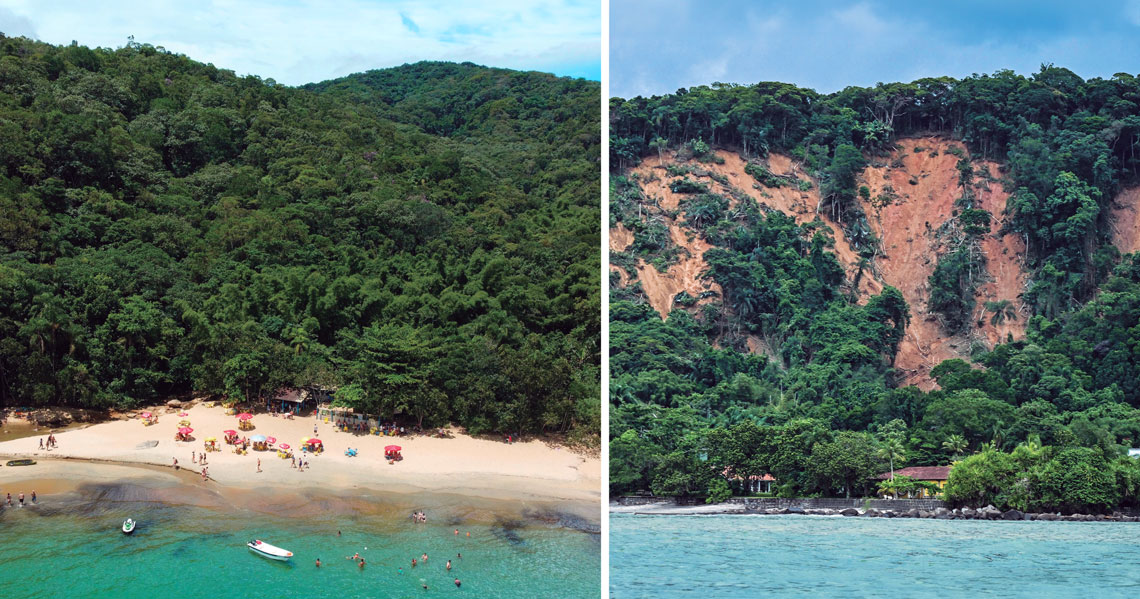
One such event, the tragedy in Vila Sahy, in the municipality of São Sebastião, on the northern coast of São Paulo (see Pesquisa FAPESP issue n° 348), prompted one of the few Brazilian academic studies linking tourism to the climate crisis. After the February 19, 2023 catastrophe, when hillside collapses caused by record rainfall of 680 millimeters in 24 hours resulted in 64 deaths, geographer Rita de Cássia Ariza da Cruz shifted her focus. “The catastrophe was literally a watershed moment in the focus of my studies,” she says.
Coastal tourism in Brazil follows a familiar formula of beaches, boardwalks, seaside avenues, and urban development
A professor in the Department of Geography at the University of São Paulo’s School of Philosophy, Languages and Literature, and Human Sciences (FFLCH-USP), she had already been bringing together researchers from various fields to study tourism since 2020, when the COVID-19 pandemic devastated the sector. Virtual meetings among colleagues led to the creation that year of a research network for pandemic times, which in 2022 became the International Research Network on Tourism and Contemporary Socio-Territorial Dynamics.
Under this umbrella, around 100 scientists from different backgrounds and from educational and research institutions in Brazil, Argentina, Portugal, and Mozambique work to produce reflections and articles on the relationship between tourism and social, economic, political, environmental, and cultural dynamics. The book Mudanças climáticas e turismo (Climate change and tourism), co-edited by Cruz, is one result of this exchange of knowledge. Published in September by FFLCH/USP and publicly available, the book examines the effects of climate change on coastal environments, the Amazon, the Cerrado, and the Pantanal, as well as the conditions under which tourism acts as a villain, a victim, or both in this scenario.
When considering global warming, the most villainous aspect of tourism is its greenhouse gas (GHG) emissions generated by transporting people from one place to another. As shown by Pnad Turismo, last year the main means of transportation used by respondents for travel was private or rental cars (50.7%), followed by airplanes (14.7%) and buses (11.9%).
In the book’s second chapter, geographer and tourism expert Isabel Jurema Grimm, from the universities of Vassouras (UniVassouras) and Santa Úrsula (USU) in Rio de Janeiro, notes that between 2009 and 2019, global GHG emissions from tourism increased by 40%. In other words, they rose from 3.7 gigatons (7.3% of global emissions) in 2009 to 5.2 gigatons (8.8% of the total) ten years later. Thus, the sector’s carbon footprint grew at an annual rate of 3.5%, more than double that of the global economy (1.5% per year) over the same period. If this rate continues, the index could double every 20 years. Grimm, one of the book’s organizers, is also the author of one of Brazil’s first doctoral theses connecting tourism and climate change, defended in 2016 at the Federal University of Paraná (UFPR).
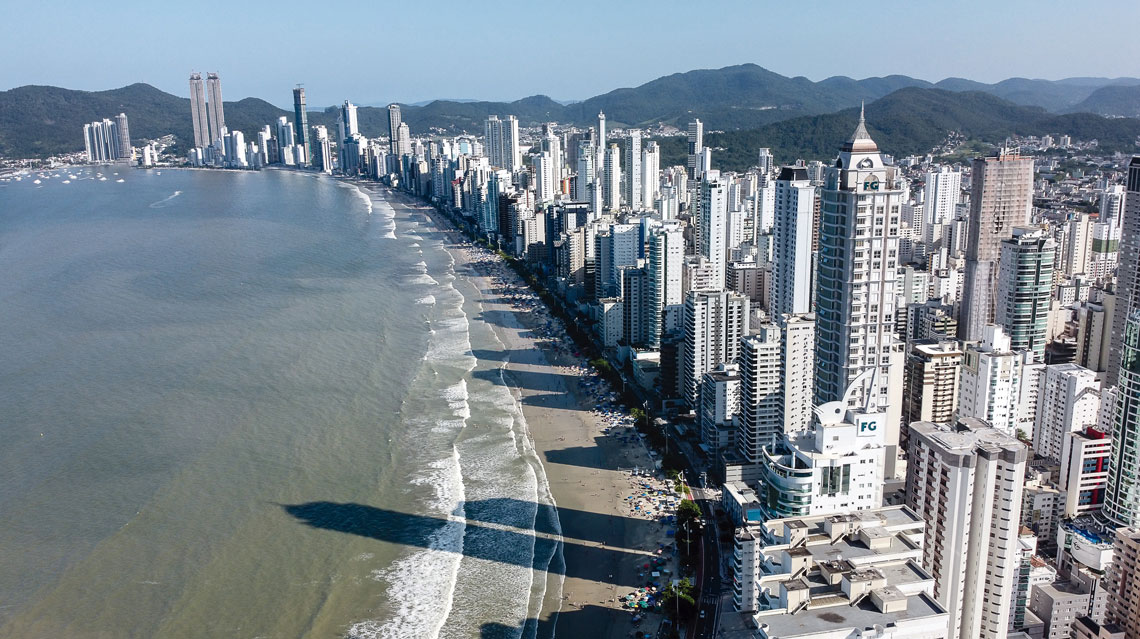
Anderson Coelho / Folhapress Balneário Camboriú waterfront, a summer resort in Santa Catarina known for its skyscrapersAnderson Coelho / Folhapress
Air travel is a major driver of these GHG emissions. According to the International Energy Agency (IEA), aviation accounted for about 2.5% of global carbon dioxide (CO₂) emissions in 2023, releasing roughly 800 million tons of CO₂ into the atmosphere. The concern grows when one considers that global leisure travel is already returning to 2019 levels—the year before the pandemic.
According to the World Tourism Organization (UNWTO), more than 1.4 billion people traveled abroad in 2024, reaching 99% of the number of international tourists five years earlier. France, which tops the ranking of the most popular destinations for foreign visitors, welcomed more than 100 million tourists last year—an increase of 2 million compared to 2023, according to the French Ministry of Economy and the UNWTO. The Olympic and Paralympic Games in Paris, the reopening of Notre-Dame Cathedral, and the commemorations of the 80th anniversary of D-Day were among its main attractions.
According to the Brazilian Tourism Board (Embratur), Brazil welcomed around 7 million international tourists between January and September 2025. Last year, the country ranked fifth in the UN Tourism list of the most popular destinations in the Americas, surpassing Argentina and trailing only the United States, Mexico, Canada, and the Dominican Republic. Globally, it placed 39th in 2024, also according to UN Tourism.
Marcus Polette, an oceanographer and geographer from São Paulo who is part of the Graduate Program in Environmental Science and Technology at the University of Vale do Itajaí (Univali) in Santa Catarina, has been studying the harmful effects of tourism on the Brazilian coast since the 1950s. Since that decade, sun-and-beach tourism has followed a formula of beaches, boardwalks, seaside avenues, and buildings. “In Brazil, boardwalks were often built on top of beaches, and several seaside avenues covered the sandbank vegetation,” he says. “The process was so rapid that these ecological systems, beaches and sandbanks, lost their role in buffering the effects of sea level rise.”
As for buildings, not even the sky seems to be the limit. Balneário Camboriú (SC), a city near Itajaí and also the subject of Polette’s research, is famous for its skyscrapers, with several around 200 meters tall and one over 550 meters under construction, expected to be the tallest in the world. According to the Municipal Tourism Secretariat, between December 2024 and March 2025, the municipality received 1.87 million tourists, including summer residents and day trippers—those who make round trips from their cities of origin.
Polette is one of the authors of the study “The coastal and marine zone of Santa Catarina in the face of climate change scenarios: Priorities for the generation of scientific subsidies,” published in June 2024 in the Brazilian Journal of Aquatic Science and Technology. He notes that clusters of tall buildings, found not only in Camboriú but also in Guarujá (SP), Fortaleza (CE), Recife (PE), and other cities, form urban canyons that intensify heat waves and vehicle pollution in their centers, and create more noise as wind circulates between them. Not to mention soil impermeabilization, which worsens already frequent flooding. In the most recent event, in January 2025, Balneário Camboriú even declared a state of emergency due to heavy rains that flooded Avenida Atlântica and other major roads.
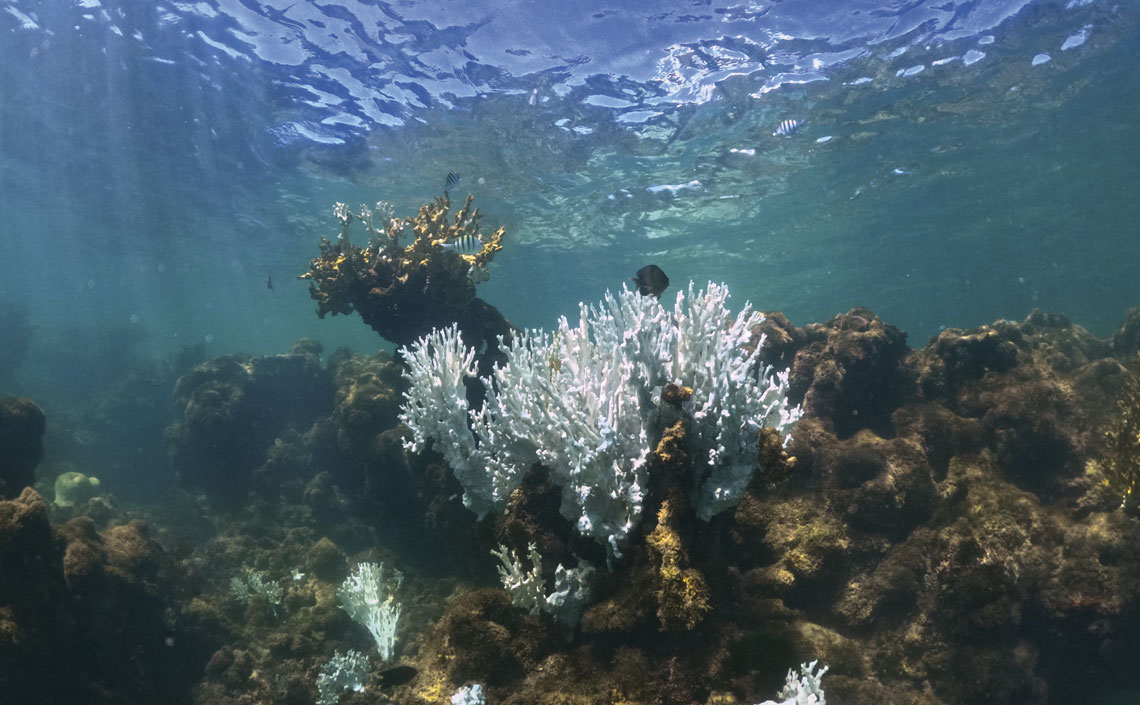
Herton Escobar / USPBleached and yellowed colonies of fire coral in Maragogi, Alagoas: this species is among the most affected by rising ocean temperaturesHerton Escobar / USP
But tourism is also a victim of the climate crisis. Regions that promote diving for coral observation, for example, are suffering from coral bleaching caused by high ocean temperatures. Bleaching is a phenomenon in which corals lose their vibrant color because they expel symbiotic algae known as zooxanthellae. These algae normally provide corals with nutrition and color, but when exposed to high water temperatures, they begin to secrete toxic substances. “Bleached coral isn’t dead, but it’s in the ICU, as it no longer has food and has an energy deficit,” explains oceanographer Miguel Mies, from the Oceanographic Institute (IO) at USP and research coordinator for the Coral Vivo project.
Created in 2003 at the National Museum of the Federal University of Rio de Janeiro (MN-UFRJ) and sponsored by Petrobras, the project has become a benchmark in research, conservation, and sustainability of Brazil’s coral reefs. A study led by the group, published in September in the journal Coral Reefs and signed by 90 researchers from 19 Brazilian institutions (15 public universities, three nongovernmental organizations, and one federal agency), as well as the University of Bordeaux (France), revealed that the heat wave that swept through the planet’s oceans in 2023 and 2024 left a significant impact on Brazilian reefs.
The team monitored 18 reef ecosystems between Ceará and Santa Catarina, along with two oceanic regions in northeastern Brazil (the Fernando de Noronha archipelago and Atol das Rocas) from August 2023 to December 2024. They recorded mass coral mortality in well-known tourist destinations such as Maragogi, in Alagoas (88%); São José da Coroa Grande and Porto de Galinhas, in Pernambuco (53% and 28%, respectively); and Rio do Fogo, in Rio Grande do Norte (38%).
The species most affected were fire coral (Millepora alcicornis), which provides shelter for fish and other invertebrates due to its branched structure, and sail coral (Mussismilia harttii), a species endemic to Brazil and already threatened with extinction. “Heat waves in the country are more intense, more frequent, and lasting longer, and this is a recipe for disaster in reef sites, as it limits any recovery,” says Mies.
In his view, tourism can serve as an ally when it promotes environmental awareness and encourages the appreciation, and therefore conservation, of coral ecosystems. At the same time, it becomes a stressor when carried out in a predatory way, through trampling, accumulated trash, and pollution from boats. “Reefs that are not protected against these local stressors are less tolerant of warming, meaning they will bleach and die at higher rates when the next heat wave arrives,” says the oceanographer.
The agenda for the 2025 United Nations Climate Change Conference, COP30, includes at least one panel dedicated to tourism. In one of the chapters of Climate Change and Tourism, researchers examine how investments by the state and federal governments, along with private companies, are reshaping the landscape of Belém, not only to host the event in November but also to prepare the city to attract international tourism in the future.
In this context, geographer Hugo Serra, from the Federal University of Southern and Southeastern Pará (UNIFESSPA) and one of the authors of the chapter, highlights the surge in real estate speculation emerging in central areas of the capital as a result of these infrastructure changes. “It is contradictory to build more high-rises in a city that serves as the gateway to the largest forest in the world,” he notes.
The story above was published with the title “Uncertain destination” in issue 357 of November/2025.
Scientific articles
MIES, M. et al. Coral bleaching and mortality across a 24° latitudinal range in the Southwestern Atlantic during the fourth global bleaching event. Coral Reefs. 2025.
PEREZ, J. A. A. et al. A zona costeira e marinha de Santa Catarina diante dos cenários de mudanças climáticas: Prioridades para a geração de subsídios científicos. Brazilian Journal of Aquatic Science and Technology. 2024.
Livro
CRUZ, R. C. A. et al. (ed.) Mudanças climáticas e turismo. São Paulo: FFLCH/USP, 2025.