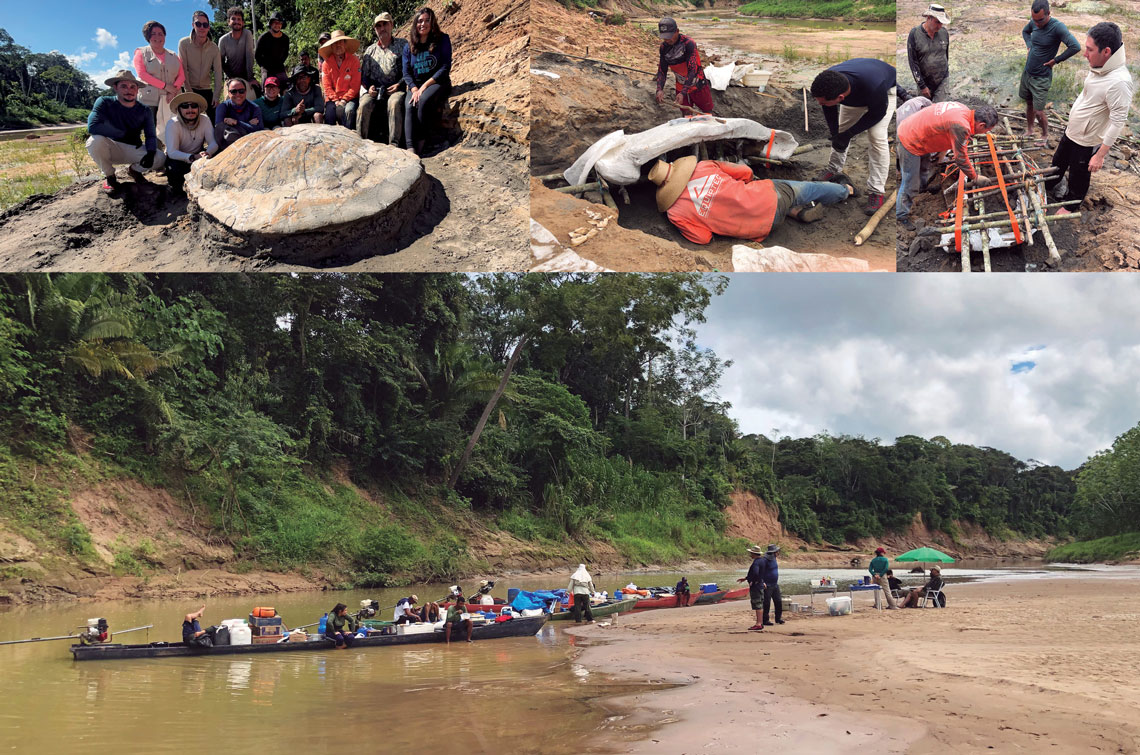
Equipe USP / UFAC / UNICAMPResearchers discovered a fossilized Stupendemys geographicus, once the world’s biggest freshwater turtle species, on the banks of the Acre riverEquipe USP / UFAC / UNICAMP
Researchers on a scientific expedition in Assis Brasil, close to the borders with Peru and Bolivia in Acre State, almost missed the fossil of a giant turtle. While two of his colleagues were heading for a nearby area, paleontologist Francisco Ricardo Negri, of the Federal University of Acre (UFAC), decided to stop and comb the margin of a cliff on the banks of the Acre river. “Suddenly Negri, clearly euphoric, started to shout and gesticulate to us. There was a shell sticking out from the ground,” recalls one of the expedition leaders, paleontologist Annie Schmaltz Hsiou, of the University of São Paulo (USP), Ribeirão Preto campus. It was Stupendemys geographicus, considered the world’s largest species of freshwater turtle, which lived between 10.8 million and 8.5 million years ago during the Miocene epoch. “It’s the most complete giant turtle shell ever found in Brazil,” she says.
The discovery was made on the very first day of fieldwork in mid-June, and it took four days to excavate all the pieces found. “We identified fragments of the shell, pelvic bones, part of a femur, and other parts of leg bone,” Hsiou goes on. The preserved shell measured more than 1 meter (m), and preliminary data indicate that the whole animal would be around 2 m long, similar to one found in Venezuela in 2020, the biggest on record until then. The sixteen-strong team was not prepared to find a fossil of this magnitude, and had to improvise a wooden base to transport it. Hsiou, who has studied fossils in the state of Acre in partnership with UFAC over the last 20 years, had visited the same region in 2022 with paleontologist Edson Guilherme da Silva, of the same university, when the pair spent nine days without any communications. This time the team had satellite internet while camping at the riverside.
– COP30 seeks more ambitious global targets to reduce emissions and curb global warming
– In 30 years, COP has become the largest annual United Nations conference
– Ane Alencar: Climate change affects everyone
– Large trees consume and store more carbon
– How tourism affects climate change and vice versa
– Ghanaian climatologist says poor countries need financial and technological support to tackle global warming
The mission is part of 22 scientific expedition projects funded through a call for proposals under the Amazonia+10 Initiative, initially a joint effort between the research foundations (FAP) of the nine Amazonian states plus FAPESP (hence the name +10), which has now been extended to include the Brazilian National Council for Scientific and Technological Development (CNPq) and research support institutions and agencies from 25 Brazilian states and countries such as the UK, Germany, Switzerland, China, France, and Guiana. The selected projects involve a total of 733 researchers from 87 institutions, participating in forest incursions to collect data, biological specimens, minerals, and artefacts of the region’s native and popular culture. According to Amazônia+10 executive secretary Rafael Andery, seven projects have now commenced fieldwork, while others are in the preparation phase. One of the requirements of the call was for each expedition to have multidisciplinary teams under the coordination of researchers funded by at least two state-level foundations answering the call, with one of them associated to higher education or research institutions based in the nine-state Legal Amazon region.
The expeditions are aimed at broadening understanding about the social and biological diversity of Amazonia, by collecting data in previously little-explored regions. “There were four objectives in the public notice. Firstly, to overcome spatial and taxonomic biases, encouraging research into largely unknown areas and groups; the second was to support ambitious fieldwork, with resources for logistics, infrastructure, and equipment,” explains Andery. The others, he says, are aimed at preserving a respectful relationship with the lands, with the effective participation of Indigenous, riverside, and Quilombola (maroon) people in the research teams, and investing in storage plans for the resulting data, preferably with Legal Amazon institutions.
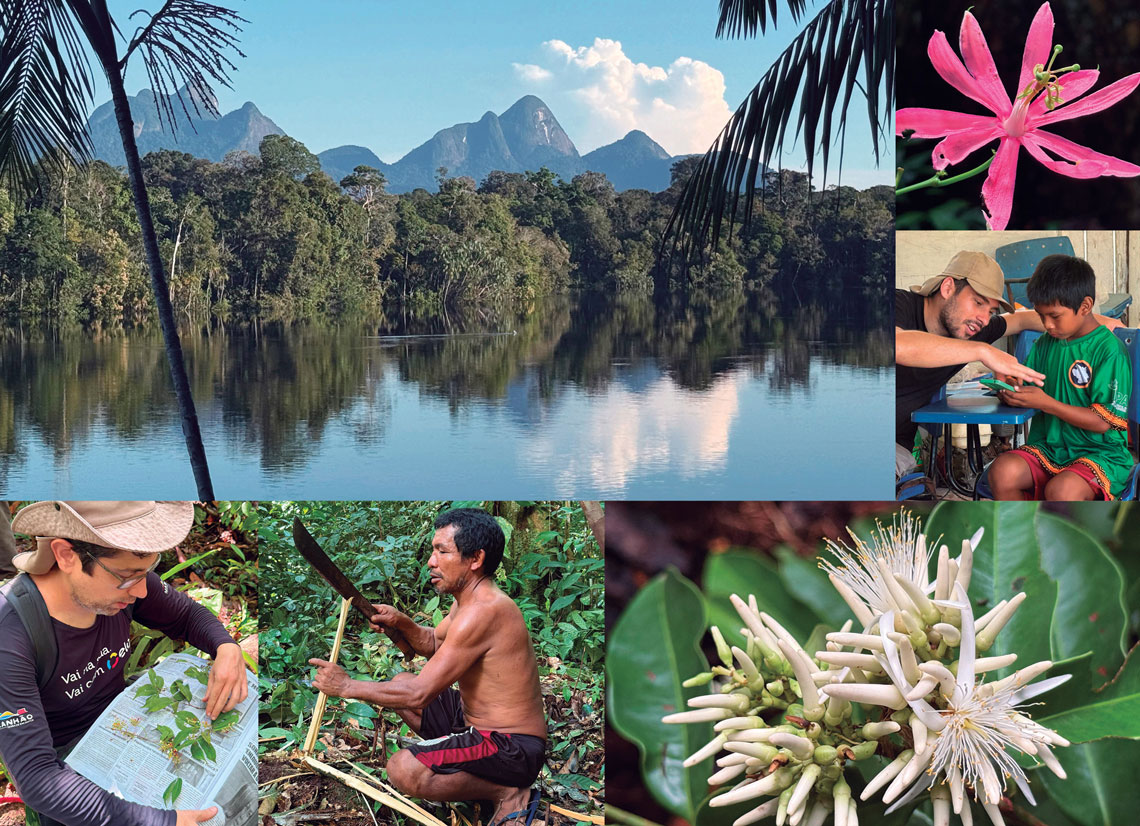
Charles Eugene Zartman Indigenous grant beneficiaries, biologists, botanists, and military personnel collected over a thousand samples of fungi, soils, and plants in locations such as the Bela Adormecida Mountain range, Amazonas StateCharles Eugene Zartman
According to the call, the data available on the biodiversity of Amazonia include a predominance of information on plants and birds, while insects such as butterflies, fungi, and bacteria are still not very well known. One of the selected projects has the remit of bridging some of this gap. During the first field expedition in July, a group of biologists, botanists, Indigenous peoples and military personnel collected over 1,000 samples of fungi, soils, angiosperms, ferns, and bryophytes from the banks of the Curicuriari River, in a region known as the Bela Adormecida mountain range, close to São Gabriel da Cachoeira in Amazonas State, and others in the environs of the municipality, such as the Itacoatiara-Mirim community.
The mountain range peaks highest at an altitude of 1,200 m; the research group traveled by boat for three hours to the community of São Jorge, and from there 30 minutes on foot along a forest trail. “We only got halfway up in ten days of fieldwork, due to the large quantities of species we found, many of which appear to be as yet unknown and will now be analyzed,” explains botanist Charles Zartman, of the National Institute for Amazonian Research (INPA), and one of the expedition leaders.
For the project, the Brazilian National Council for Scientific and Technological Development (CNPq) is sponsoring 11 Indigenous beneficiaries with high school-level education from the Yanomami, Tucano, Baré, Nheengatu, and Baniwa ethnicities. “The idea is to arouse young people’s interest in the plants and fungi that feature in their day-to-day village life,” says Zartman. The researchers attended a gathering promoted by the Yanomami Women’s Association in the region, where they presented the research and heard about the community’s needs. “Many older women asked us to help create catalogues of traditional medicinal plants, because their daughters no longer believe in their recipes,” Zartman adds. “One of our tasks will be to work with these women to put together a photo-illustrated catalogue with scientific and Indigenous names, along with information on traditional uses.”
Zartman says that the majority outlay on the expedition is on travel. “More than 60% of our budget goes toward fuel for the boats.” Large, slow-moving canoes hewn from timber and known as bongos, with long-tail outboard motors, are used, while smaller motorboats make for faster travel. “From São Gabriel to the district of Pari-Cachoeira, close to the border with Colombia, it takes three days by motorboat, and around a week by bongo,” explains the botanist. The project is supported by seven FAPs, from the states of Amazonas, Pará, Maranhão, Paraíba, São Paulo, Rio de Janeiro, and the Federal District, and has international backing from UK Research and Innovation (UKRI), the United Kingdom’s leading research support agency, and the Natural History Museum in London.
Back in the Bela Adormecida mountains, another expedition deployed to the field in October and is set to conduct its work at altitudes above 500 m in Pará and Roraima States. The researchers will be looking for aquatic insects, primarily dragonflies, and zooplankton, shrimps, and crabs, of which current collections in Amazonia come from areas close to large urban centers such as Manaus and Belém. “We will be going to previously unsampled areas. Knowledge is extremely limited about the aquatic insects in this region,” says biologist Renato Tavares Martins, who held a postdoctoral position at INPA when the project was approved, and currently occupies a post at Fiocruz in Rio de Janeiro.
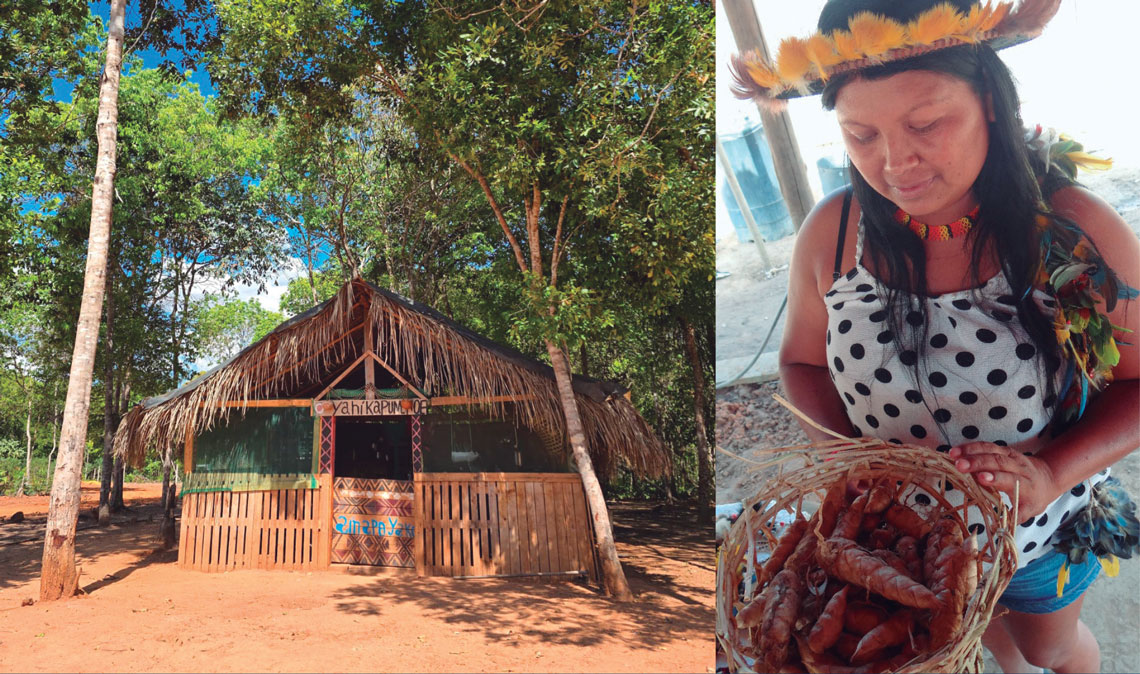
Irene Lôbo | Moacir HaverrothVanessa Nambikwara (right), resident of the Tirecatinga Land in Sapezal (MT), with arrowroot, a resistant crop amid the loss of traditional foodsIrene Lôbo | Moacir Haverroth
He says that many current species distribution models are based on data from areas of low altitude in Amazonia, so there is a lack of information representing higher regions where fauna is adapted to different conditions, such as lower temperatures. “Climate change will likely force many species to migrate to higher altitudes. Having a knowledge of this wildlife is paramount for refining conservation strategies,” Martins observes. A third focus of the project is education and science communication, and the team intends to liaise with native peoples and produce books on insect biology and ecology in Indigenous languages—the first was released in Portuguese, Neenghatu, and Tukano in October, and examines just what aquatic insects are. The team is staffed by researchers from different states—Amazonas, Roraima, Pará, Goiás, São Paulo, Santa Catarina, and Rio de Janeiro.
The first field trip has also been completed in a project aimed at rescuing culinary customs and reducing food insecurity in villages on the Tirecatinga Indigenous Land in Sapezal, Mato Grosso State. In August, researchers from the federal universities of Mato Grosso (UFMT) and Goiás (UFG), and from the Brazilian Agricultural Research Corporation (EMBRAPA) Food & Territories Unit in Maceió (Alagoas), visited villages such as Serra Azul and interviewed residents. “The Indigenous Land is in a region of Cerrado (wooded savanna) surrounded by sizable cotton, corn, and other crop farms, which puts a lot of pressure on local communities,” explains biologist Moacir Haverroth of EMBRAPA, a participating researcher on the project.
“The Indigenous villages are small and scattered, and this has resulted in a loss of traditional seeds and difficulties in ensuring food security. At the same time, the consumption of industrialized and ultra-processed foods has increased.” The aim is to rescue important food varieties adapted to the environment, which the Indigenous peoples say have been lost. “These include the traditional ‘soft’ corn made from colored grains—a common Indigenous staple—popcorn, and nut corn, currently unavailable or restricted in certain communities,” says Haverroth. Another project stage involves the evaluation of food preparation methods in the villages. “The idea is to sit down with the communities and think of alternative ways to increase the shelf life of foods, while promoting their full use, including their sale,” says the biologist.
The expeditions also seek to explore the knowledge of other traditional peoples. “Quilombolas have a strong connection with the Amazon forest,” explains environmental engineer Celso Henrique Leite Silva Junior, of the Amazon Environmental Research Institute (IPAM); he coordinates a project set to undertake its first expedition next year funded by four FAPs, including FAPESP, and with overseas backing. “We have looked at maps that show the overlap between biodiversity data gaps and Quilombola lands in Amazonia.” The idea is to use technologies such as remote censoring and environmental DNA sequencing to compile biodiversity inventories, and the expeditions are planned to take place in two communities in Pará, and one in Amazonas. There are fifty scientists on the project, two of which are Quilombolas. “Overseas researchers usually go to Amazonia, collect the data they need with the help of traditional peoples, then publish their articles and disappear. We are looking to create a kind of long-term monitoring that the Quilombolas themselves can continue.”
The story above was published with the title “Uncharted forest” in issue 357 of November/2025.
Republish