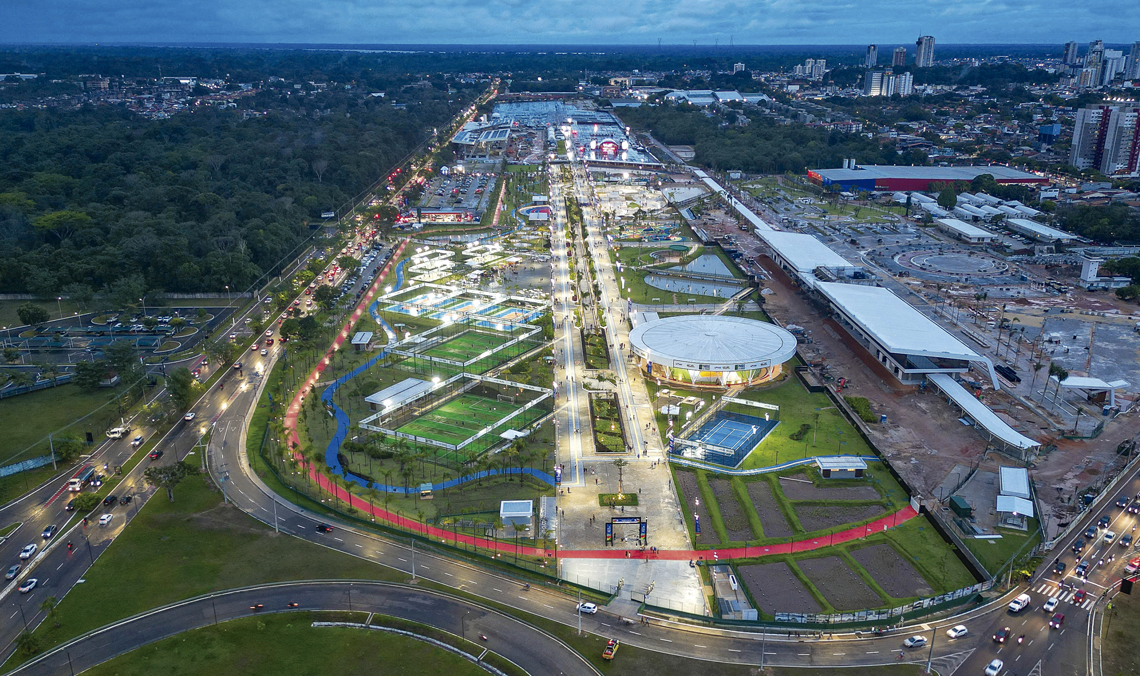
Belém—the tropical Brazilian city set to host this year’s Conference of the Parties (COP) under the UN Framework Convention on Climate Change (UNFCCC)—is the first in the country to welcome the event, although Brazil has played an indirect role in the early origins of the conference. Back in 1992, Rio de Janeiro hosted a landmark global summit on the environment and sustainable development, widely known as the Earth Summit, Rio ‘92, or Eco ‘92. Held 20 years after the Stockholm Conference in Sweden—the UN’s first major attempt to grapple with humanity’s relationship with the natural world—the Earth Summit drew an extraordinary 103 heads of state or government. The summit wrapped up with a slate of documents and commitments.
Among the key outcomes was the creation of three multilateral treaties under the auspices of the UN, all of which remain in force today: the Convention on Biological Diversity (CBD), the UN Convention to Combat Desertification (UNCCD), and the UN Framework Convention on Climate Change (UNFCCC). The first annual climate-convention meeting, COP1, was held in 1995 in Berlin, Germany. Roughly 4,000 people attended. About a quarter were delegates from national governments, another quarter represented civil-society organizations, and fully half were journalists covering the summit.
– COP30 seeks more ambitious global targets to reduce emissions and curb global warming
– Ane Alencar: Climate change affects everyone
– Large trees consume and store more carbon
– How tourism affects climate change and vice versa
– Ghanaian climatologist says poor countries need financial and technological support to tackle global warming
– Scientific expeditions head into little-explored areas of the Amazon
Since then, COP—celebrating its 30th edition this November in Belém—has become the premier global platform for debate and, especially, for negotiation among the 198 parties (197 nations plus the European Union) that have signed on to the climate convention. Its most enduring contribution has been the creation of two major international agreements aimed at cutting greenhouse-gas emissions, the main driver of global warming.
The first was the Kyoto Protocol, negotiated in 1997 during COP3 in Kyoto, Japan. Kyoto set binding emissions-reduction targets only for industrialized nations, which historically have been the largest emitters due largely to their reliance on fossil fuels. The second is the Paris Agreement, adopted in 2015 at COP21, which requires every signatory to submit voluntary five-year emissions-reduction plans known as Nationally Determined Contributions (NDCs). In practice, because it is broader in scope, the Paris Agreement has effectively superseded the Kyoto Protocol.
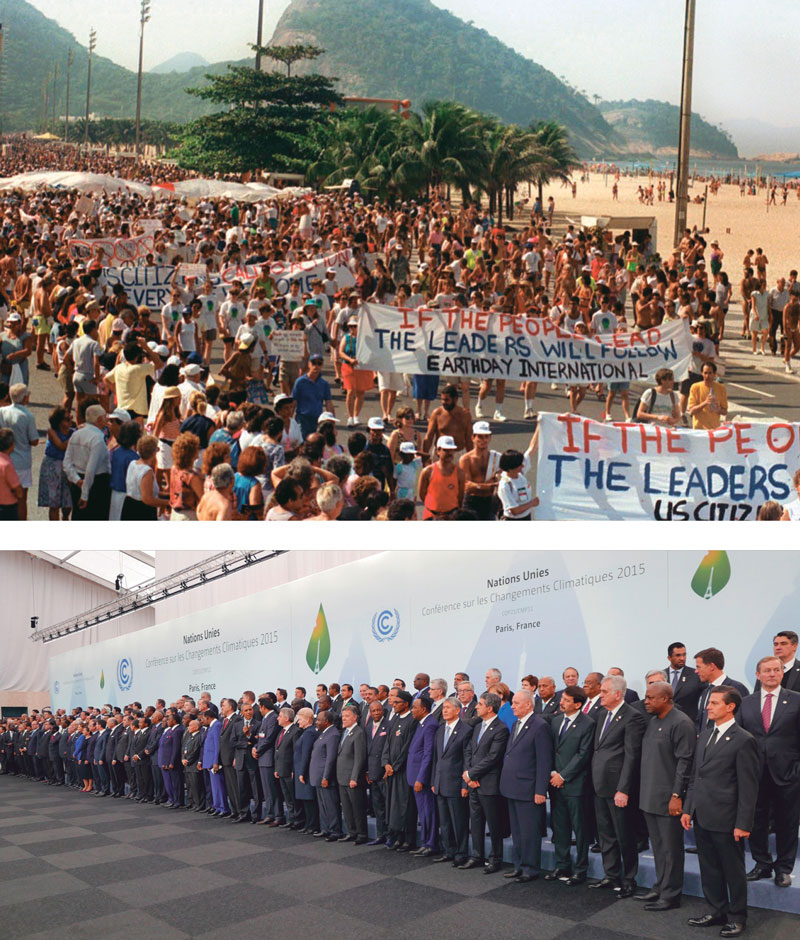
Jorge Araújo / Folhapress | Wikimedia CommonsA protest in Copacabana during the Earth Summit; below, COP21, where the Paris Agreement was signedJorge Araújo / Folhapress | Wikimedia Commons
“The creation of COP played a key role in slowing the rise of global emissions, even if there’s still a long road ahead,” says agricultural engineer Jean Ometto of Brazil’s National Institute for Space Research (INPE). “Back in the 1990s, emissions were growing about 2% a year; today that rate is roughly half.” But curbing global warming ultimately requires emissions to fall in absolute terms—not just grow at a slower rate.
Over its three decades, COP has expanded so dramatically that it’s now the single largest annual gathering convened by the United Nations, which stages global meetings on everything from economics and science to public health, migration, human rights, and geopolitics. At COP28 in 2023, held in Dubai in the United Arab Emirates, attendance hit a record 80,000 people. International media outlets also noted the conspicuous presence of oil-industry lobbyists. The next conference, in Baku, drew 54,000 participants.
Some researchers argue that COP has become too high-profile for its own good. “There should not be big fanfare and whatnot. It’s detrimental to the UN process,” said Benito Müller, a climate-policy scholar at the University of Oxford, in an interview with Undark shortly after the latest conference. “We’re going to get climate fatigue.” In Belém, organizers expect roughly 40,000 people to pass through Parque da Cidade—the main venue for COP30—each day.
“The message coming out of COP has to be taken seriously,” says climatologist Carlos Nobre of the University of São Paulo’s Institute for Advanced Studies (IEA-USP). “We need to move beyond emissions-reduction pledges and into concrete action. The world has more than enough financial capacity to support both the clean-energy transition and climate-adaptation efforts in developing nations.”
COP’s influence has grown in tandem with a mounting body of scientific evidence showing that global warming—the engine driving climate disruption—is overwhelmingly the result of human activity, particularly the burning of fossil fuels. The vast scale of the conference, combined with the slow, consensus-based decision-making of a multilateral forum, has fueled criticism of the most recent COPs.
“The climate agenda is critically important, but it needs to advance alongside the biodiversity agenda,” says ecologist Ima Vieira of Pará, a senior advisor to the president of the Brazilian Funding Authority for Studies and Projects (FINEP). “Right now, climate is occupying almost all the space in global environmental discussions, and that imbalance needs to be fixed.” The climate-change agenda emerged within scientific circles and the broader environmental movement, which during the era of the Earth Summit focused far more on preserving biodiversity and securing indigenous lands than on global warming itself.
As the steep rise in global temperatures has grown into an existential threat for humanity—reinforced with each new assessment from the UN-created Intergovernmental Panel on Climate Change (IPCC), established in 1988—issues related to protecting native plants and wildlife have steadily lost prominence.
The story above was published with the title “From Berlin to the Amazon” in issue 357 of November/2025.
Republish