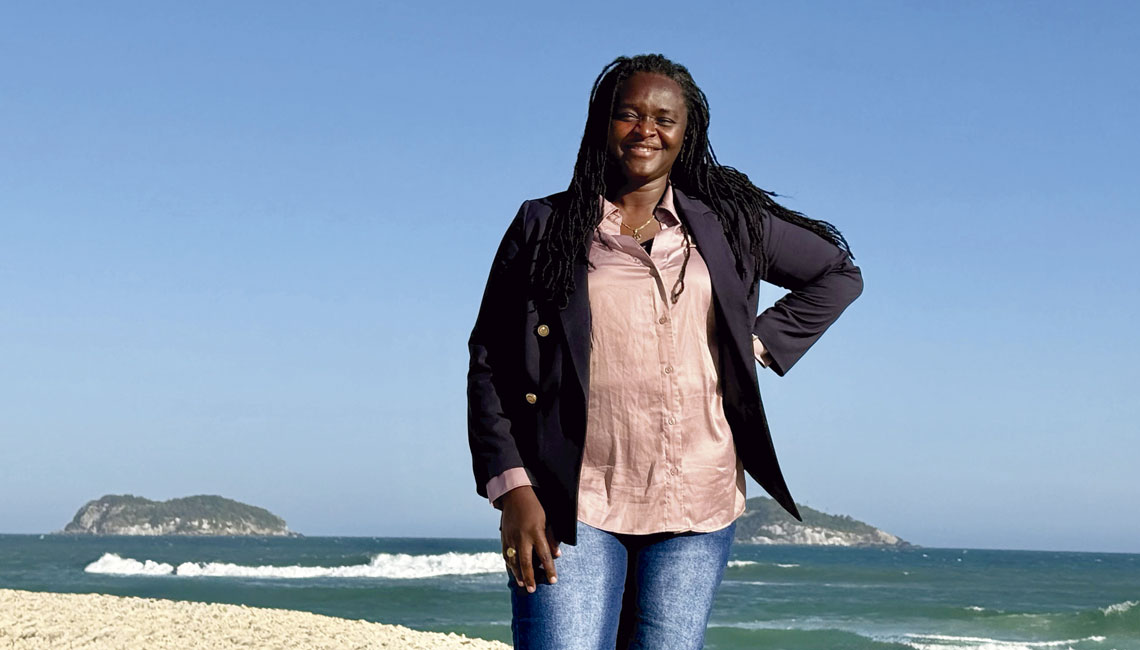
As a little girl, Nana Ama Browne Klutse would be told that she should study a branch of science because her interest in nature led her to “ask too many questions.” With biology not her strong point and chemistry seeming difficult, she opted for physics. Born in Ghana, West Africa, Klutse graduated at the country’s University of Cape Coast, and was planning to pursue astronomy; opportunity, however, led her in another direction and she became an internationally renowned climatologist.
Specializing in dynamic climate phenomena, particularly African monsoons, Klutse has conducted research at the Ghana Space Science and Technology Institute and has managed Ghana’s Remote Sensing and Climate Centre. A professor at the University of Ghana, she was a lead author on the physical sciences chapter of AR6, the Sixth Assessment Report by the UN’s Intergovernmental Panel on Climate Change (IPCC). Published in 2021, the document confirmed that recent changes in Earth’s climate are a result of human activity. Now 44, she is vice president of Working Group 1, which will analyze the scientific grounds for the seventh report, due for publication in 2029. She has been running the Ghanaian Environmental Protection Agency since January.
– COP30 seeks more ambitious global targets to reduce emissions and curb global warming
– In 30 years, COP has become the largest annual United Nations conference
– Ane Alencar: Climate change affects everyone
– Large trees consume and store more carbon
– How tourism affects climate change and vice versa
– Scientific expeditions head into little-explored areas of the Amazon
Klutse paid her first visit to Brazil in September to attend the 17th General Conference of The World Academy of Sciences (TWAS), held in Rio de Janeiro in partnership with the Brazilian Academy of Science (ABC), where she spoke on the impacts of climate change. “We are getting to a critical point where the state of our climate system could be irreversible,” she said.
Klutse spoke to Pesquisa FAPESP on the effects of climate change observed to date in Africa, about what to expect from the next IPCC report, and her expectations for COP30. Read on for the highlights.
How do you see the climate of our planet today, and what should we expect in the coming years?
We have seen a continual rise in temperatures associated with ongoing greenhouse gas emissions into the atmosphere. We support a global reduction in emissions, but we are yet to achieve the proposed goal. There are frequent spells of elevated temperatures, flooding, drought, and coastal erosion due to rising sea levels in some regions. Developing countries are especially vulnerable because they lack the capacity to adapt and respond to climate impacts. Poor infrastructure in many countries means that they cannot protect against floods. In more inland continental regions, droughts are a threat to food security, as some communities have no capacity to store food for long, so dry farming—which depends on rainfall for irrigation—is practiced. All of this influences migration and can lead to violence and warfare. The situation is worse in poor countries.
To contain a temperature increase of 1.5 degrees Celsius (°C) above preindustrial levels, greenhouse gas emissions need to be cut. How are we doing?
After the Paris Agreement, the IPCC published a report on the impacts of the 1.5 °C increase across all regions of the world. It was abundantly clear that if this level of warming were allowed to continue, there would be serious consequences for food security due to heatwaves and rainfall, crop pests, and diseases. That’s why we support cutting emissions—and we must halve them by 2030. Some countries are making the effort, but not all. The UN and notably the United States withdrew their support for mitigation strategies and other actions to control climate change; this affects the way people will tackle it, and how countries will be striving to achieve their emission reduction goals. A number of countries went to great lengths to prepare their nationally determined contributions (NDC), submitted to the United Nations Framework Convention on Climate Change (UNFCCC). Many governments, however, may not have the financial or technological means to implement their NDCs.
In 2024, the average temperature increase on the planet exceeded 1.5 °C in certain months. What could happen across the different regions of the world in the short term?
We are getting to a critical point where the state of our climate system will be irreversible. We need to understand that average warming of 1.5 °C means a higher rise in some regions—close to 2.4 °C in Africa, with even greater increases in tropical areas. Temperatures have been rising year-on-year. At the critical point we may have difficulty understanding how rain patterns, temperatures, and ocean circulation will come to behave.
What climate change impacts are expected in Africa?
As I said, an increase of 1.5 °C means a lot more heat in Africa. Most countries on the continent are already facing the impacts of this warming—we have problems with flooding, droughts, and rising sea levels in coastal regions, and the temperature increase also means disease among human populations, and crop pests. Farmers are struggling to predict when the rains will begin so they can plant, and when they need to use agricultural inputs in their fields. Most farmers in Africa depend on the rain. Irrigation is not freely available, nor is financial backing for crop irrigation and water resources. Several African countries already suffer from food insecurity and health issues, with heatwaves increasing skin diseases and malaria cases.
Is any particular region more affected?
The whole continent. The highlands and mountains suffer during droughts, while flooding afflicts the lowlands; coastal regions are reporting erosion. The poorest countries and those at war, such as Sudan and South Sudan, where food supplies are limited, suffer most from these issues.
Africa has always been a very low emitter of greenhouse gases, but must be one of the worst-affected continents. How can African countries develop without repeating the emission patterns of other continents?
We call that an ethical dilemma. The African continent emits less, but suffers more from global warming and its impacts. African countries need to unite and mobilize to—I don’t want to use the word “fight,” but to go after what is due to them; we need to deal with this dilemma. The reason we participate in conferences of the parties (COP) is that we hope to reach an agreement by which higher-emitting developed countries support those that have low emissions, but which also have forests that help remove carbon dioxide from the atmosphere. Most African countries have forest coverage, which can generate carbon credits. There needs to be a standard for the commercialization of these credits, in which developed countries cannot cheat countries under development. We need to get around the table and use simple language and transparency to discuss how African countries will survive the impacts of climate change, to the benefit of both developed and developing countries.
Many countries are already vulnerable, particularly those in development, as they lack the capacity to adapt
What do you expect from the upcoming COP?
A lot of people have lost hope and interest in COP. Every year we gather to discuss the commitments of developed countries to those in development, but these commitments are not being honored as expected. I hope that this can begin with COP30 in Brazil, with a clear pathway approved to implement agreements on climate funding, technology transfer to support the adaptation and implementation of mitigation measures, and the UN Loss And Damage Fund.
At the preceding COP, approval was given for annual support of US$300 billion, well short of the expected US$1.3 trillion. Can this change now?
It’s a struggle, but I believe that something can be done. We need to get the right people around the negotiating table to tell our [developing countries’] stories in the right way, and clearly define our needs. I have hope for COP30.
Ghana is not far from the Congo tropical forest, the world’s second biggest. How well is that forest preserved, and what are the main threats?
The threat these days comes from population growth, urbanization, and the impacts of gold mining. In the forests of Ghana, new factories are being installed and roads laid, with agricultural lands expanding.
How much of the forest has been felled to date?
I couldn’t tell you. Part of it has been affected by mining and urban expansion, but we have some reserves in which the forest is well preserved.
In Brazil, the Amazon forest is important for the country’s climate. How does the Congo forest influence the climate in Africa and other regions?
The Amazon forest also influences the climate in Africa, as does the Congo Basin Rainforest. We also have a vast forest in Ghana that contributes to the distribution of rainfall and humidity across the country.
What will the next IPCC report show us?
We take a few steps forward with every report. If you go by the comments made by stakeholders, people clearly want practical reports rather than just rhetoric. One issue is that the IPCC report is not prescriptive; it provides guidelines for each government to formulate policies. We are listening to stakeholders, and hope that the next report will be more practical and concise. The last one was very voluminous.
You participate in an experiment known as CORDEX. What is that?
CORDEX (Coordinated Regional Climate Downscaling Experiment) is a global project where we use models to understand climate behavior. We believe that a single model does not have the resolution required to make the forecasts we would like, so to that end we use 25 climate models developed by institutions from around the globe to understand climate and make projections for the future. The experiment has helped us to understand Africa’s climate system. I have conducted a lot of research using these models to come up with an overview of the many variables in Africa such as temperature, volume of rainfall, wind systems, and the number of consecutive dry and rainy days. The sixth IPCC report cites multiple papers we published about CORDEX, divided across 14 regions of the globe.
Why are regional models important?
Because we need to understand the climate in different regions to understand it globally. As part of CORDEX-Africa we analyzed the same variables, for example the variability of rainfall in each of the African subregions. We did the same with the wind system, temperature, water availability, and for agricultural variables. We wanted to fully understand the African climate system.
How does the climate in Africa affect the climate in other regions of the world?
I can give you an example: years ago, a tsunami that hit the Eastern Seaboard of the United States was found to have originated on the coast of Senegal; it then slowly grew and matured just off the United States, where in response the US government set up an ocean institution on the coast of Dakar, Senegal, to study cyclones and hurricanes that may originate there. The different climate systems are global and may affect different regions of the planet. Think about El Niño and La Niña. They occur in the Pacific Ocean and affect the climate in Africa, including Ghana.
Nations need to collaborate with each other; we have but one planet, and the actions of each country affect the others
What led you to focus on physics and climate studies?
Physics was natural for me when I was growing up—I was always asking questions about nature from an early age. They told me “You’re asking too many questions. When you go to school, study science.” At university I had to choose a specific area. Biology was interesting, but I didn’t get good grades in that, and chemistry was difficult for me, so I studied mathematics with a specialization in physics. My first real interest was in astronomy, but I didn’t get the opportunity to do a master’s in that. I managed to get funding and went to Cape Town, South Africa, to do my doctoral research on climatology, then did a sandwich program with the Abdus Salam International Centre for Theoretical Physics (ICTP) in Trieste, Italy. My advisors put me in touch with different programs, such as CORDEX, which opened up new opportunities for me. I worked on that, also at the World Climate Research Programme (WCRP), and at the IPCC.
As a woman, what challenges did you face in your country to become a researcher? Was there prejudice?
Unfortunately, that’s normal—in a lot of departments or meetings, I am the only woman. It can feel lonely. I’ve sought out women to advise on postgraduate programs so that we could get them into the area. Unfortunately, I’ve only managed to advise one on her doctoral program; there’s another woman doing an undergraduate course, and I hope she graduates soon, then I will have two mentees. I tried to get more women involved, but none are available for training.
Did you not get disheartened?
Perhaps it is the family aspect that would discourage me. The accepted culture in Ghanaian society is that after a certain age, women should marry and have children; this leads a lot of women to interrupt their careers to raise a family. I was not affected in this way because I was focused on my career despite having a family.
How easy is it to access schooling and higher education in Ghana, particularly for women?
It is free of charge for all. Female students are prioritized for admission to a certain extent. The pass mark for entry to some universities is one point lower for women, in an effort to arouse their interest. Some corporations offer scholarships to female science students.
You run a project to encourage girls and women to pursue careers in science. How does that work?
I run a mentoring program for girls, visiting schools and giving talks, especially to female students. I tell them about the advantages of doing a degree and choosing a scientific career. I use my own example, describing the opportunities I gained by pursuing a scientific vocation; this has helped a lot of women to choose this area. I also provide individual advice and encouragement to female students, including those who have already decided on their future professional life.
In what areas is scientific research more developed in Ghana?
In the biological sciences—research into nutrition and health is a little more well-developed than climate studies, but the latter is on the up.
What are the primary research centers?
We have institutions such as the Center for Scientific & Industrial Research, and the Ghana Atomic Energy Commission (GAEC), of which the country’s Space Science and Technology Institute (GSSTI) is a part. Most of the universities also run research programs, including my institution, the Ghana Environmental Protection Authority.
Wealthy countries invest 2% or more of their GDP in research, while the figure in developing countries is around 1%. What about Ghana?
We’re a long way short of that. Researchers receive grants for studies at their institutions. We still do not have a national research fund, but there are smaller ones for climate and electronic waste. We also receive support from overseas; for example, I am involved in research into solar radiation modification funded by the Degrees Initiative, an international NGO that supports southern hemisphere research into SRM as an intervention to reduce global warming.
What made you decide to take on an active role in the politics of your country some years ago?
I’ve worked with research all my life. I produce results that I hope will form the basis for public policies, but I don’t see that happening. The people we vote into high-ranking political posts undervalue research outcomes. So I thought: “Why don’t I get in there and do something?” I tried twice for a place in the Ghanaian Parliament, but lost in the election. It is worlds away from science. After the second attempt, I decided to support a presidential candidate. He won the election, but was disappointing. Now I am the executive director of Ghana’s Environmental Protection Authority. In that role I can implement ideas arising from research outcomes. I’m still working in my area, but my actions are geared toward implementation.
Would you like to say anything else?
We need to inform people about the need for countries to collaborate with each other. Developed countries should support those in development, financially and technologically. We have but one planet, and the actions of each country affect the others. When we talk about adaptation funds, all we want to do is adapt to the impacts of climate change. We are not receiving money from abroad to get rich. The developed world needs to understand the situation.
Has the developed world been shortsighted in that respect?
I wouldn’t say shortsighted, but many of them don’t care about developing countries, which support wealthier countries by offering their natural resources.
The above interview was published with the title “Nana Klutse: In the hope for practical actions” in issue 357 of November/2025.
Republish