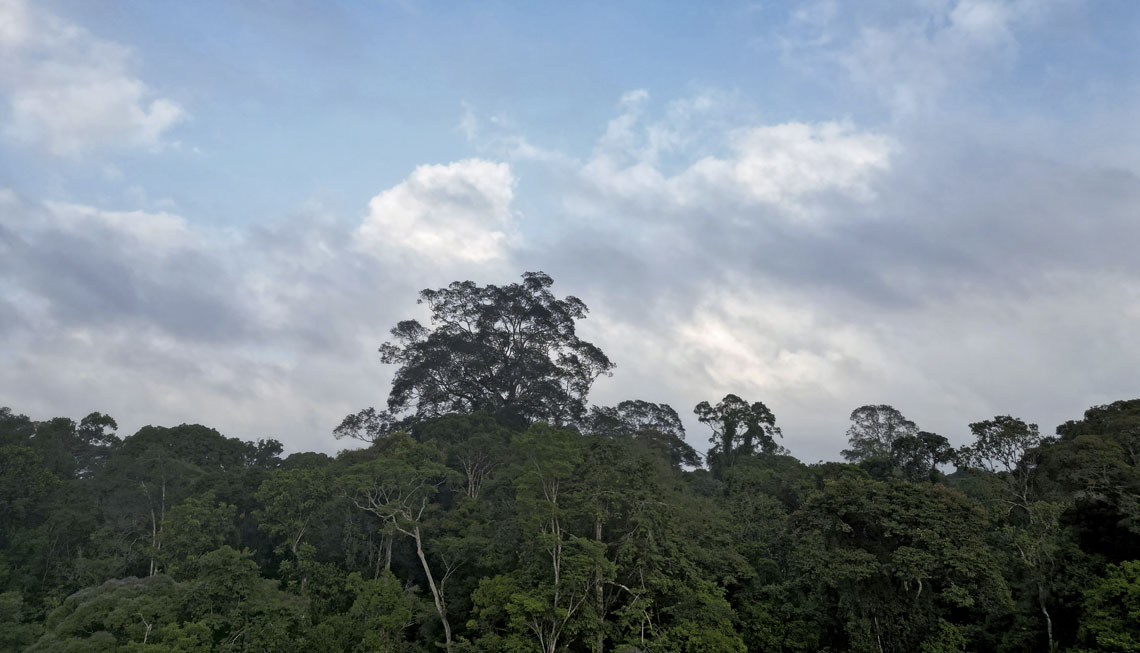
The imminence of Amazonia reaching the point of no return and being degraded is much talked about. In recent years, the news has been getting worse, with the forest’s dwindling capacity to capture carbon. Now the good news: the trees are getting bigger across the region, possibly due to increased carbon gas (CO₂) levels in the atmosphere, according to an article published in the scientific journal Nature Plants. This growth has been more evident in larger trees.
The data show that the average size of Amazonian trees has grown by 3.3% per decade over the last 30 years, while the maximum size has increased by 5.8%. This indicates that larger trees have benefited more from the higher levels of carbon in the air, although sizes in the entire forest have increased generally. Throughout the Amazon basin, the amount of tree trunks with diameters in excess of 40 centimeters (cm) has risen. “We use forestry inventories from a network known as RAINFOR; searches make forest measurements at each site over a long period of time,” explains Brazilian ecologist Adriane Esquivel-Muelbert of the UK’s University of Cambridge, lead author of the article.
Members of the network deploy to the field periodically in all nine Amazonian countries and measure the same trees, identifying which have survived.
– COP30 seeks more ambitious global targets to reduce emissions and curb global warming
– In 30 years, COP has become the largest annual United Nations conference
– Ane Alencar: Climate change affects everyone
– How tourism affects climate change and vice versa
– Ghanaian climatologist says poor countries need financial and technological support to tackle global warming
– Scientific expeditions head into little-explored areas of the Amazon
Specialists use the basal area measurement method, which quantifies how much space the trunk would occupy if the tree were cut at a point 1.3 meters (m) above the ground. “If the trunk is deformed in any way, we measure higher up,” says Esquivel-Muelbert. “We paint a mark on the trunk to ensure that measurements are always taken at the same point.”
Changes can then be identified year-on-year, and the outcome of this is that trees with trunks exceeding 40 cm in diameter are increasingly numerous and larger, but growth in trees with trunks between 10 and 20 cm is not so easily perceptible. “The ideal scenario would be to calculate the biomass of each tree, but we’re unable to make precise enough estimates of tree heights to monitor their growth,” she adds.
The article interprets the observation as a sign of forest resilience in the form of carbon storage; the bonus is removing the CO₂ from the atmosphere, but this carbon sink function is not enough to offset the damage caused by unchecked emissions around the world.
The result is surprising because recent studies indicate that Amazonia may be becoming more carbon source than carbon capture (see Pesquisa FAPESP issue n° 321). “These studies are conducted on a different scale, and look at several different types of forest at the same time, including deforested areas,” says the ecologist. “We only look at the mature forest, and this makes a big difference.” In other words there is no discrepancy because the study objectives are different. Deforested areas are indeed a source of carbon, and the issue arises when they predominate over mature forest. “The carbon-sink capacity of mature forests is on the decline, to the point where one forecast states that this effect will no longer exist in 2030,” she says. To reverse this, the permanence of these forests must be guaranteed and fossil fuel emissions reduced.
Demonstrating that older, bigger trees are resisting climate change could be a positive signal that they are more resilient than calculated to date. Forest experiments simulating extreme drought have previously shown that very large trees may die suddenly in very dry conditions due to hydraulic failure in the transportation of water from the roots to the leaves (see Pesquisa FAPESP issue n° 238).
Droughts are increasingly more frequent and pronounced in this current climate change situation.
This, however, is not what we see in reality, says Brazilian biologist Paulo Bettencourt, a researcher at Cardiff University in the UK. “Currently, large trees are no more limited by drought than small ones, in the areas where they grow,” says Bettencourt, who studies giant trees in the Brazilian Amazon (see Pesquisa FAPESP issue n° 336) and in Malaysia. “Our monitoring in Malaysia has shown that the trees are fine after a severe drought, and that they acclimatize by changing the characteristics of their wood.”
Preliminary data on the red angelim (Dinizia excelsa) in Amapá indicate the same result.
Figuring out how trees that can grow to more than 40 m in height overcome the hydraulic challenge is still a matter for discussion, but Bettencourt has progressed in his investigation. Extending above the forest canopy also puts trees at risk of attracting lightning during storms and cracking in strong gusts of wind—risks that would appear to be more significant.
“We’re still trying to understand giant trees,” says the researcher from Cambridge. “As they are rare among the landscape, it’s difficult to understand what causes their mortality.” Bettencourt adds that studies need to be reconsidered. “A lot of inventories are based on land lots of 1 hectare (ha), in which you will find no more than ten large trees,” she explains. “If one falls, the effect on the biomass in that lot is considerable.” The biggest 1% of trees accumulate around 50% of vegetable biomass. Esquivel-Muelbert has been working with 1,500-hectare lots in a bid to overcome this limitation.
Biologist Rafael Oliveira, who participated in the “ESECAFLOR” drought experiment and the study led by Bittencourt into the giant trees of Amapá, says that Esquivel-Muelbert’s research may suggest a change in the view of Amazonia’s role in the carbon cycle.
“Anyone that studies vegetation knows that it has mechanisms to resist multiple stress factors,” he says. The collapse scenario at the forefront of projections come from climate models that consider neither the physiology of the trees, nor a comprehensive sample of the landscape. “We need more studies on a local scale to monitor what the vegetation is doing.”
Esquivel-Muelbert highlights the need for long-term investment by several countries in this type of study. “We will only understand the dynamic of the forest if we keep compiling detailed inventories,” warns the researcher; she considers long-term data an important scientific infrastructure.
She also maintains that experiments are essential for understanding the mechanisms. One of them is AmazonFACE, set to discharge CO₂ into stretches of the Amazon forest to gauge the reaction of the vegetation. “I wonder if they are more invested in fruit or in growth,” ponders the ecologist.
The first gas emission pulse, Bittencourt explains, is set to take place soon, with the aim of officially commencing the experiment in early 2026. “Perhaps the trees increase their biomass, perhaps they become more drought-resistant by transpiring less, perhaps they have already reached their acclimatization limit and will not change at all,” he proposes.
In his view, the most exciting part of the Cambridge article is that observation on Amazon-basin scale perfectly fits the latest perceptions.
The story above was published with the title “The carbon eaters” in issue 357 of November/2025.
Republish